



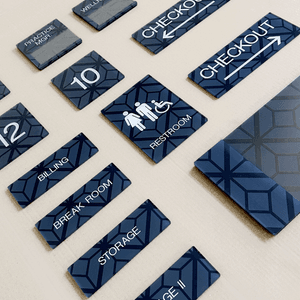
What Is ADA-Compliant Signage?
ADA-compliant signage refers to signs that meet the accessibility requirements set by the Americans with Disabilities Act. These signs are designed to be usable by everyone - including people who are blind, have low vision, or use wheelchairs - and they show up in places you probably walk past every day: restroom doors, conference rooms, elevator panels, stairwell exits, and building directories.
The goal is straightforward: every person who enters your building should be able to navigate it independently, regardless of ability.
Who Has to Have It?
Under federal law, ADA signage is required for commercial buildings that are open to the public - including spaces that were constructed after 1993 or have undergone renovation. That covers a wide range of facilities:
- Hospitals, clinics, and medical offices
- Office buildings and professional suites
- Schools, colleges, and universities
- Apartment complexes and multifamily developments
- Government buildings and municipal facilities
- Retail spaces and restaurants
If your building has permanent rooms with assigned functions - restrooms, offices, conference rooms, utility spaces, stairwells - those rooms need ADA-compliant identification signs. It's not just new construction, either. Existing buildings are required to meet compliance standards where it is "readily achievable," meaning high-traffic areas like entrances, restrooms, and elevators are typically the first priority.
Skipping compliance carries real consequences. According to the U.S. Access Board, first-time ADA violations can result in fines up to $75,000, with additional penalties for ongoing issues.
What Makes a Sign ADA-Compliant?
ADA signs aren't just about adding Braille to a door plate. There are several specific requirements that must all be met together:
Raised (Tactile) Characters
Room identification signs must feature raised letters that can be read by touch. These must be uppercase, use a sans-serif font (like Helvetica or Arial), and be raised at least 1/32 inch above the sign surface. Character height must fall between 5/8 inch and 2 inches, with consistent spacing between letters.
Grade 2 Braille
Braille is required directly below the tactile text on all permanent room identification signs. The ADA mandates Grade 2 contracted Braille - a shorthand system that improves reading speed and is standard for public signage. The dots must be rounded, properly spaced, and placed with adequate clearance from the text above.
Color Contrast
Signs must have strong visual contrast between the characters and the background. While the ADA doesn't name a specific contrast ratio, industry standards recommend at least 70% contrast - think white on navy, black on white, or cream on dark brown. Equally important: the surface must be non-glare. Glossy or reflective finishes make signs harder to read and can disqualify an otherwise compliant sign.
Mounting Height and Location
ADA signs for room identification must be mounted on the wall adjacent to the latch side of the door - not on the door itself. The baseline of the lowest tactile character must be at least 48 inches from the finished floor, and the highest must be no more than 60 inches. There must also be at least 18 inches of clear floor space in front of the sign so that a wheelchair user can approach and read it without obstruction.
Can You Customize ADA Signs to Match Your Brand?
Yes - and this is one of the most common misconceptions about ADA signage. The standards regulate tactile elements, Braille, contrast, and placement, but they leave a lot of room for customization in color, finish, and material. ADA signs can be fabricated to match your brand palette, incorporate your logo, or complement the architectural materials of your facility - as long as the contrast and readability requirements are preserved.
At Keen Signs & Graphics, we've produced ADA signage packages for healthcare systems like Piedmont Hospital and Burke Health, university campuses like Augusta Technical College, medical practices like Family Physicians of Evans, and multifamily developments like The Row apartment complex - each with its own brand standards and design requirements. ADA compliance and good design aren't mutually exclusive.
What About Wayfinding and Directory Signs?
Not every sign in your building requires tactile characters and Braille. Signs that provide direction to spaces - such as overhead directional arrows, lobby directory boards, and informational signs - must meet visual requirements like contrast and legibility, but tactile and Braille elements are only required for signs identifying permanent rooms or spaces.
That said, a well-designed wayfinding system works hand-in-hand with your ADA room signs to create a complete, navigable environment. If someone uses a directory to locate a department and then can't identify the room once they arrive, the system has failed.
How Long Does an ADA Signage Project Take?
For most commercial projects, ADA signage takes approximately 4 to 6 weeks from initial consultation through installation. Larger campus projects or those requiring custom finishes may take longer. We work from your architectural plans, room schedules, or brand standards to ensure every sign is accurate and compliant before it goes into production.
If you're working with a general contractor on a new build or renovation, the earlier you bring your sign company into the process, the smoother it goes. ADA signage is typically part of a Division 10 specification, and coordinating placement and installation with the construction schedule avoids delays at project closeout.
Ready to Get Your Building Into Compliance?
Keen Signs & Graphics is a full-service sign company in Augusta, GA, with deep experience in ADA-compliant and architectural signage for commercial, healthcare, educational, and multifamily facilities throughout the CSRA. We handle the entire process - from consultation and design through manufacturing and installation - so you don't have to manage it piece by piece.
If you're not sure whether your current signage meets ADA requirements, or if you're planning a new build or renovation, we're happy to talk through your project. Call us at (706) 364-2151 or submit an estimate request at keensigns.com to get started.

