



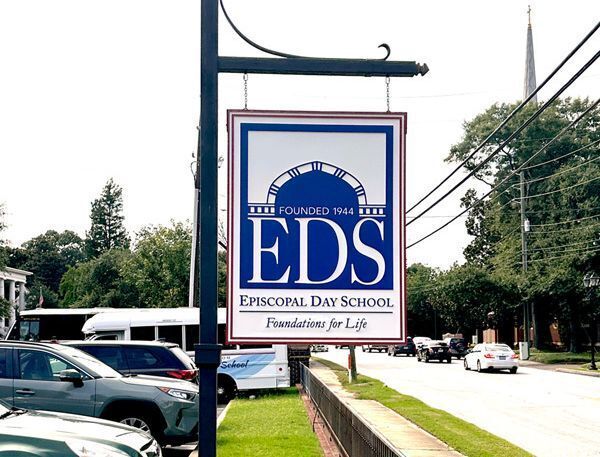
Augusta, GA
There is a difference between a sign that marks a location and a sign that marks a legacy. Walk into any established law firm, golf club, or historic subdivision entrance, and you will notice it immediately: the lettering is not just applied to the surface. It is carved into it. The edges catch the light differently. The surface has depth, texture, and weight. That is the hallmark of a sandblasted or routed sign, and it is one of the most effective ways for a business to communicate permanence before a customer ever walks through the door.
At Keen Signs & Graphics, we design, fabricate, and install sandblasted and routed signs for businesses across Augusta, Evans, Martinez, and the entire CSRA. This guide covers what these signs are, why they matter, and whether they are the right investment for your brand.
What Are Sandblasted and Routed Signs?
Sandblasted and routed signs are created using a subtractive process. Instead of printing or mounting flat characters onto a surface, the background material is carved away, leaving the letters, logo, or decorative elements raised in relief. The result is a three-dimensional sign with depth, shadow, and texture that flat signage simply cannot replicate.
Sandblasting uses pressurized abrasive media to erode the background material around a protected design, creating a soft, textured surface with raised letters. CNC routing uses a computer-guided cutting tool to carve precise channels, grooves, and edges with sharp, repeatable detail. The two techniques are often combined: routing for the precise letterforms, sandblasting for the background texture.
The finished product reads as handcrafted, permanent, and intentionally premium. It is signage that says, "We have been here, and we plan to stay."
Who Needs a Sandblasted or Routed Sign?
Not every business needs this level of finish, and that is exactly the point. Sandblasted signs are a deliberate choice for brands that want to stand apart from the generic, the temporary, and the disposable.
Law firms and professional offices use them to project authority, tradition, and trust. Golf clubs and country clubs choose them for entrance monuments that match the established character of the property. Subdivisions and gated communities rely on them for entrance signs that need to look attractive and official for decades. Funeral homes and churches appreciate the dignity and timelessness of carved lettering. Historic districts, bed and breakfasts, and boutique inns use them to signal authenticity and local character.
In short, if your brand is built on longevity, reputation, or heritage, a sandblasted or routed sign is one of the most honest marketing investments you can make.
Material Showdown: HDU vs. Wood
The material you choose for a sandblasted sign matters as much as the design. In the Augusta area, where summer heat indexes climb and afternoon thunderstorms roll through with little warning, material selection is not just aesthetic. It is structural. High-Density Urethane (HDU): The Modern Standard HDU is a closed-cell rigid foam substrate engineered specifically for signage. It has become the industry standard for carved and sandblasted signs for good reason.
HDU is impervious to moisture, rot, and insects. In Georgia humidity, that is not a minor benefit; it is the deciding factor. It carves cleanly with no grain inconsistencies to surprise the fabricator or compromise fine detail. It accepts automotive-grade paint and stain-grade finishes so convincingly that many viewers cannot distinguish it from real wood. It is also significantly lighter than solid wood, which reduces structural load and installation complexity.
The only real downside is a higher upfront material cost than basic wood. However, when you factor in the elimination of re-sealing, insect treatment, warping repair, and eventual replacement, HDU is almost always the lower lifetime cost.
Wood: The Traditional Choice
Redwood, cedar, and sign-grade mahogany have been used for carved signage for generations. They offer authentic natural grain and a genuinely organic feel. For some historic preservation boards or clients with strong aesthetic preferences, wood is specified explicitly.
But wood in the CSRA is high-maintenance. Our humidity promotes rot and warping. Termites and carpenter bees view unprotected sign faces as an invitation. The natural grain, while beautiful, is inconsistent and can compromise very fine detail in small lettering or intricate logos. Wood requires regular re-sealing and inspection, and even with diligent care, its lifespan in this climate is shorter than HDU's.
The Verdict for Augusta and the CSRA
For most businesses in Augusta, Evans, Grovetown, Aiken, and North Augusta, HDU is the smarter long-term investment. It gives you the look of carved signage without the vulnerability of organic material.
Wood remains the right choice when a historic district or preservation guideline requires it, or when a client specifically wants the authentic grain and is prepared to commit to the maintenance schedule. At Keen Signs, we work with both materials and will help you choose based on your site, your budget, and your timeline.
Sandblasted vs. Dimensional Letters: Which Is Right for Your Monument Sign?
If you are comparing options for a monument or building sign, you may also be considering dimensional letters. Both are premium exterior solutions, but they serve different design goals.
Dimensional letters are individual characters, logos, or elements mounted to a sign face or wall. They create a modern, layered look with clean shadows and the ability to mix materials and finishes. They work beautifully for contemporary office buildings, retail centers, and brands that want flexibility.
Sandblasted and routed signs are carved from a single panel. The design and background are continuous. The effect is more traditional, more integrated, and more textured. This approach excels when the sign is a monument or entrance feature, when the brand calls for an old-world or established feel, or when the surrounding architecture is stone, brick, or traditional siding.
If your budget is tighter or you anticipate frequent rebranding, dimensional letters may be the more practical route. If you are building an entrance sign meant to last twenty years and anchor your property's identity, sandblasted HDU is hard to beat. Keen Signs fabricates both, and we are happy to walk you through which approach fits your specific project.
Historical and HOA Restrictions
Parts of Augusta, including Olde Town and Summerville, have historic district guidelines that may restrict signage materials, illumination, or placement. Some subdivisions and HOAs in Columbia County and Aiken County explicitly require carved, wood-look, or monument-style signage at community entrances. If your property is subject to design review, we can help you navigate the approval process and produce a sign that satisfies both the board and your brand.
What that process looks like at Keen Signs
Every sandblasted sign we produce follows a clear process from concept to installation.
Step 1: Design consultation. We review your brand, your site, and your goals. We help you select material (HDU grade and thickness), finish, and mounting method.
Step 2: Digital preparation. Your logo and lettering are converted to a carving-ready file. We determine the depth of relief, texture style, and edge profile.
Step 3: Fabrication. Our CNC router cuts the primary shapes and letterforms. Sandblasting adds the background texture and softens edges for a hand-crafted appearance where desired.
Step 4: Finishing. We prime, paint, and seal the sign in-house using automotive-grade coatings. Gold leaf or metallic accents are applied here if specified.
Step 5: Installation. We mount the sign to a monument structure, post system, or building wall, ensuring structural integrity and proper alignment.
From approved design to installed sign, the timeline is typically three to four weeks. Rush timelines are available for certain projects; contact us to discuss your schedule.
Budget Expectations
Sandblasted and routed signs are a premium product. They are not the right solution for a temporary promotion or a tight startup budget. Costs vary based on size, material, finish complexity, and installation requirements. A small carved plaque costs less than a full monument entrance sign with gilded lettering, concrete footing, and internal lighting.
However, the value proposition is straightforward. A properly fabricated HDU sign with a quality finish can last fifteen to twenty years with minimal maintenance. Over that same period, a business might replace a cheaper sign two or three times, plus the labor and permitting costs each time. Sandblasted signs are a front-loaded investment that pays off in longevity and the unspoken credibility they lend your brand every single day.
Ready for a Sign That Outlasts the Georgia Heat?
If your business, development, or organization is ready for signage that looks as permanent as your reputation, Keen Signs & Graphics is here to help. We design, fabricate, and install sandblasted and routed signs for clients throughout Augusta, Evans, Martinez, Grovetown, Hephzibah, North Augusta, Aiken, and the surrounding CSRA.
Call us at (706) 364-2151 or click here to enter project details to receive a free estimate.
Frequently Asked Questions
How long does a sandblasted HDU sign last?
With proper automotive-grade paint and routine maintenance, a sandblasted HDU sign typically lasts 15 to 20 years in the Georgia climate. Wood signs, by comparison, often require significant refinishing or replacement within 7 to 10 years.
Can HDU really look like wood?
Yes. With proper texturing, grain patterns, and stain-grade finishes, HDU can be nearly indistinguishable from real wood to the casual observer. It offers the aesthetic without the maintenance liability.
Do I need a permit for a sandblasted monument sign in Augusta?
Yes. Most permanent exterior signs in Augusta-Richmond County, Columbia County, and Aiken County require a sign permit. We are familiar with local sign ordinances and can help you navigate the permitting process as part of your project.
Is sandblasting better than CNC routing?
They produce different effects. CNC routing is ideal for precise grooves, sharp letterforms, and detailed logos. Sandblasting creates a softer, textured background with a more organic, hand-carved appearance. We often combine both techniques on the same sign to achieve the best result.
Can a sandblasted sign be illuminated?
Yes. While sandblasted signs are often non-illuminated, they can be paired with gooseneck lighting, in-ground spotlights, or integrated LED backlighting for nighttime visibility. We can design the sign and lighting scheme together to ensure the final installation meets your needs.
