



What Organizations are required to comply with ADA Standards?
The Americans with Disabilities Act has been the law of the land since 1990, and after 36 years you might assume every storefront, office, and clinic has its signage sorted. In practice, ADA signage is one of the most commonly overlooked requirements in commercial buildings - and one of the easiest to get right.
Here's a plain-English guide to what the law actually requires, what it doesn't, and where businesses most often trip up.
Who Has to Comply?
Title III of the ADA covers "public accommodations", which is most businesses that remain unlocked for public can walk into: restaurants, retail stores, offices, medical practices, hotels, salons, and more.
New construction and altered spaces must fully comply with the 2010 ADA Standards for Accessible Design. Existing buildings are required to remove barriers when it's "readily achievable" to do so.
Which Signs Need Raised Letters and Braille?
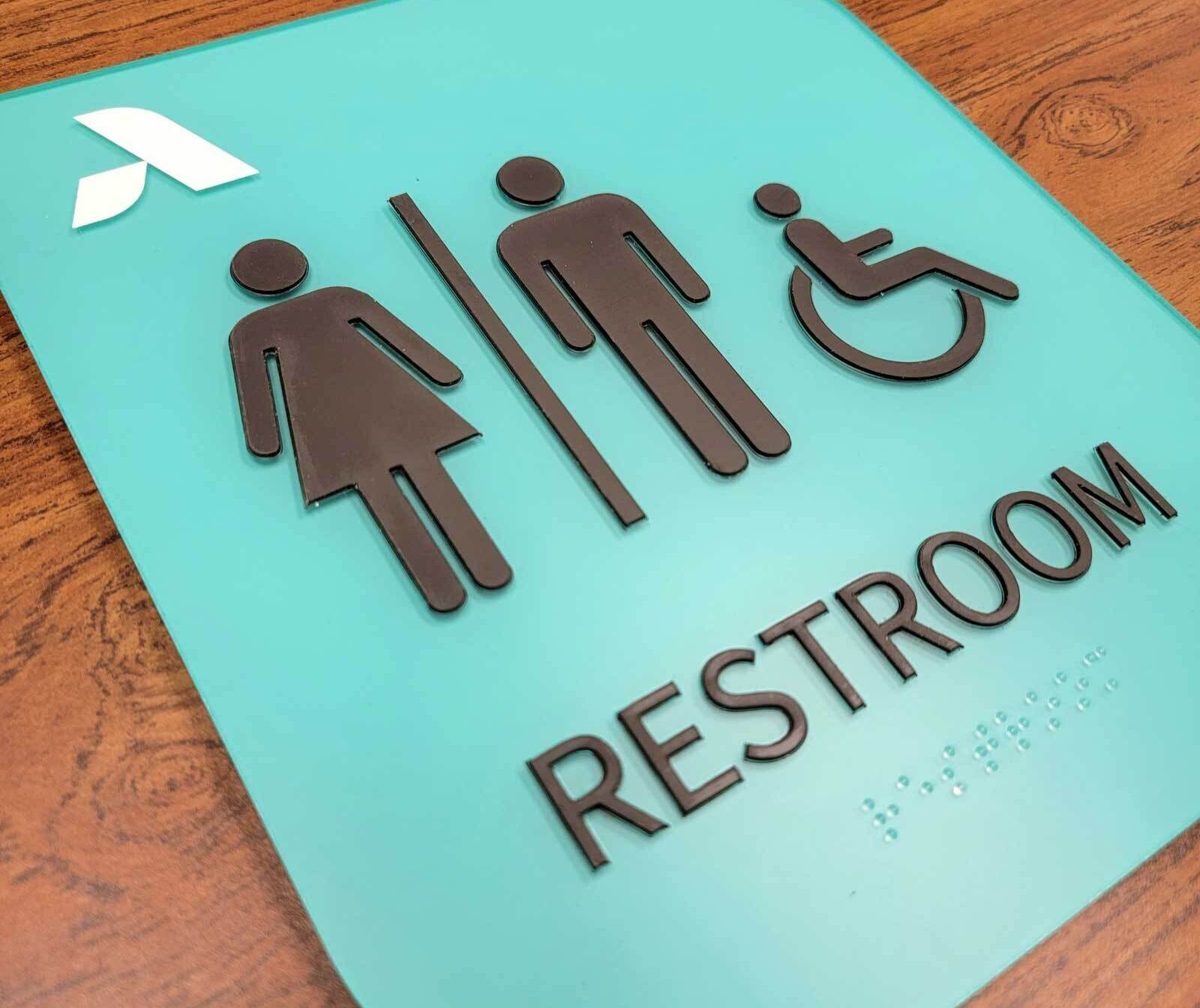
The rule of thumb: if a sign identifies a permanent room or space, it must have tactile (raised) characters and braille.
That includes:
- Restrooms
- Exits, stairwells, and floor identifications
- Individual offices and rooms with permanent numbers or designations
The key word is "permanent." If a sign would stay in place even after a tenant moves out, a room number, a restroom, a stairwell; it needs tactile letters and Grade 2 braille.
Which Signs Don't?
Plenty of familiar signs are exempt from the tactile and braille requirements, which surprises a lot of people:
- Overhead and hanging signs
- Wall-mounted directional signs ("Restrooms ->")
- Building directories and wayfinding maps
- Menus, table numbers, and other text that changes
- Temporary signs displayed for seven days or less
(Parking signage is its own category with separate federal and state requirements. Accessible space and van-accessible signs have their own rules under Georgia law.)
The Specs That Trip People Up
This is where most non-compliant signs fail. The 2010 Standards are specific:
- Raised characters must be at least 1/32 inch deep, in a sans serif font, in uppercase, sized between 5/8 inch and 2 inches tall depending on viewing distance.
- Grade 2 braille must be placed directly below the corresponding text.
- The finish must be non-glare. A polished brass plaque looks beautiful and fails the glare requirement.
- Contrast matters: light characters on a dark background or dark on light. The commonly used guideline is 70% contrast.
- Placement: tactile characters must be mounted 48 to 60 inches above the floor, measured to the baseline of the characters, on the latch side of the door with 18 by 18 inches of clear floor space for someone approaching to read by touch.
The Most Common Mistakes We See
- Glossy finishes. Shiny metal and laminate create glare that defeats low-vision readers.
- Wrong mounting height. Signs installed at whatever height "looked right" on install day.
- Decorative fonts. A beautiful script font is unreadable as raised characters.
- Braille on the wrong signs. Directories don't need it; permanent room signs do. Money spent in the wrong place.
- Laser-cut DIY braille. Braille has precise dot spacing and shaping rules. Incorrect Grade 2 braille is worse than none, because it reads as gibberish to a braille reader.
Why This Isn't Just About Doing the Right Thing
Demand letters and drive-by ADA lawsuits are a real, ongoing part of doing business. Federal civil penalties run up to $75,000 for a first violation and $150,000 for subsequent ones. And roughly one in four U.S. adults lives with a disability, so compliant signage isn't just legal protection; it's customers who can actually find your restroom.
A Note for Georgia Business Owners
Georgia enforces its own state Accessibility Code, which is based on and generally consistent with the federal ADA standards, and accessibility compliance is reviewed as part of the building permit process. When in doubt, confirm with your local permitting office.
How Keen Signs Makes This Easy
This is the part we do every week. Keen Signs & Graphics designs ADA signage that passes inspection and still looks like it belongs in your space, with correct fonts, non-glare finishes, proper Grade 2 braille, and installation at the exact required heights. We work with office buildings, medical facilities, schools, and retail spaces throughout Augusta and the CSRA.
Ready to make sure your signage is compliant? Call us at (706) 364-2151 or request an estimate via our website.
Note: This article summarizes ADA signage requirements as of its publication date and is provided for general information, not legal advice. Standards and penalty amounts are adjusted over time. Always confirm current requirements with the U.S. Department of Justice or your local permitting office, or let us handle it for you.
