



Signage that Works in Medical Offices
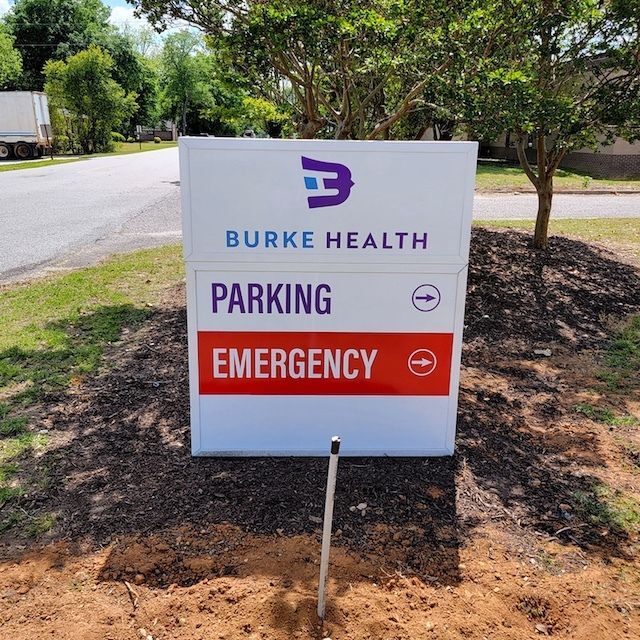
Back in the spring, we published a planning guide to signage for hospitals and larger healthcare facilities. It covers ADA requirements, campus wayfinding, and exterior identification at scale. But not every healthcare project is a hospital. A lot of our week is spent on the buildings patients actually visit most: medical office buildings, standalone practices, dental offices, physical therapy clinics, and specialty practices across Augusta and the CSRA. The stakes are a little different here, and so is the signage.
Consider this the companion guide. Here is what a medical office needs to get right, from the parking lot to the exam room door.
Exterior: being findable beats being fancy
Patients navigating to an appointment are often anxious, running late, or both. Your exterior sign has one job: confirm they are in the right place and point them to the right entrance.
For a practice in a shared medical office building or a converted house, that usually means a monument sign or a blade sign visible from the road. For a suite inside a larger building, it means clear suite identification at every entrance. If delivery drivers and new patients can find you without calling for directions, your sign is doing its job.
We fabricate and install illuminated monument and building signs for medical clients across the region, including the lighted monument sign at Self Regional. Illumination matters for any practice with early or late appointments, which in healthcare is most of them.
The waiting room: the first interior impression
Patients spend more time in your waiting room than anywhere else in the building. The signage there should lower stress, not add to it.
That starts with an obvious reception sign: your practice name, styled to match your brand, placed where a patient naturally looks when they walk in. From there, think about the quiet questions every patient has. Where do I check in? Where are the restrooms? Is this where I wait for lab work? Small directional signs answer those questions without making anyone ask out loud.
One note on materials: interior signs in healthcare take constant cleaning. Acrylic and aluminum panels with printed or cut vinyl hold up to hospital-grade disinfectants far better than unpainted wood or bare foam signs. That is a detail worth specifying up front, not discovering after the first deep clean.
Exam rooms and restrooms: ADA signage is federal law
Any medical office open to the public needs ADA-compliant signage on permanent rooms. Exam rooms, restrooms, and consultation rooms all need tactile characters, Grade 2 Braille, the right contrast, and the right mounting height.
Medical offices carry more ADA signage than almost any other building type, because nearly every interior space is a permanent room. We build complete ADA sign packages for healthcare clients, including room identification for Burke Health and Piedmont Hospital. If you are moving into a new suite or renovating one, the smart move is to have the full room sign schedule done as one coordinated order rather than adding signs one at a time.
Wayfinding: the department maze problem
Medical office buildings grow by accretion. A practice starts in Suite 100, expands into 110, and adds a lab down the hall. Ten years later, patients are wandering hallways that make perfect sense only to the staff.
A simple wayfinding system fixes that. It does not have to be elaborate. It needs consistent color or iconography for each department, directional signs at every hallway decision point, and a building directory at the main entrance. We built exactly this kind of directory system for the Piedmont Oncology facility, and it changed how easily visitors move through the building.
The test is simple: walk in as if you were a first-time patient with a 2:00 appointment. If you hesitate at any hallway, that spot needs a sign.
A good season to plan it
Medical offices tend to plan sign projects between the holidays and tax season, when patient volume dips and staff have time for a walkthrough. If your suite is getting a refresh in the new year, the sign schedule should be ordered now so fabrication and installation land before your busy season returns.
If you are planning signage for a practice or medical office in Augusta or the CSRA, we handle the whole process, from design and permitting to fabrication and installation. Take a look at our healthcare signage work, or reach out for a walkthrough of your building.
