



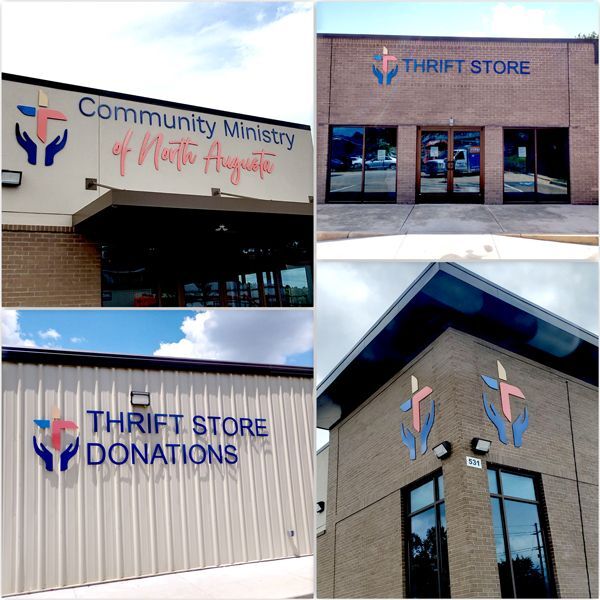
There's a reason the most recognized brands in the world of banks, hospitals, universities, and corporate headquarters almost never use flat painted letters for their lobby walls or building facades.
It's not just aesthetics. It's psychology.
Research in environmental psychology shows that three-dimensional signage generates more engagement than flat alternatives. The depth triggers something in the brain: raised letters read as substantial, permanent, and professional. As Identity Group notes, "the added dimension of 3D signage can often be perceived as a mark of quality." Your sign is making a judgment call about your business before your customer consciously registers what it says.
Dimensional signs aren't just a design preference. They're a communication tool. And if you've ever wondered what actually goes into making one, this is the guide.
What Are Dimensional Letter Signs, Exactly?
Dimensional letter signs are individually cut letters, numbers, or logos fabricated from solid materials and mounted to a wall, building facade, monument base, or raceway to create a raised, three-dimensional appearance. Unlike flat printed signs or vinyl lettering, they physically project from the surface.
They can be used indoors (lobby walls, reception areas, hallways) or outdoors (building exteriors, monument sign faces, storefronts). They can be illuminated or non-illuminated. They can be sleek and modern, warm and artisan, or boldly corporate. The material is what drives all of that.
The Materials That Make It Work
This is where most people have questions - and where the real craft lives. Here's how the main options break down:
Acrylic
Acrylic is the workhorse of dimensional lettering. It's versatile, precise, and available in a wide range of colors, finishes, and thicknesses. Glossy acrylic has a sharp, contemporary look that works beautifully in modern offices, healthcare lobbies, and retail environments. It can be laser-cut to tight tolerances and can even be backlit for dramatic after-hours visibility.
It's also one of the more budget-friendly choices for interior applications, which makes it a popular option for growing businesses that want a polished look without an outsized investment.
We used acrylic for projects like the Boys & Girls Clubs of the CSRA exterior sign and the American Board of Family Medicine's dimensional panel - both of which needed to read professionally and hold up over time.
Aluminum and Metal
When a project calls for that undeniable sense of weight and permanence, metal is the answer. Aluminum is the most common choice - it's lightweight relative to its durability, weather-resistant, and available in brushed, polished, or painted finishes. Bronze and brass bring warmth and old-world authority to the right setting. Stainless steel reads clean and high-end.
Metal dimensional letters are frequently mounted with standoffs (small posts that hold the letter slightly away from the wall), which creates a natural drop shadow and adds even more depth. Halo-lit metal letters - where LED lighting is placed behind the letter to create a glow effect - are among the most visually striking options in the industry.
The Augusta University Skywalk sign is a great example of what the right metal application can do in a high-traffic institutional environment.
HDU (High Density Urethane)
HDU is a rigid foam product that's become a staple of the sign industry for good reason. It's extremely lightweight, machines beautifully, takes paint well, and can mimic the appearance of wood or carved stone at a fraction of the weight. For large-format dimensional lettering - think big exterior building IDs or monument sign faces - HDU is often the smart call.
Routed HDU can achieve incredible detail, including beveled edges and carved textures that flat-cut materials simply can't replicate.
PVC
PVC sheet material is another cost-effective option for interior dimensional letters. It's smooth, lightweight, and takes vinyl wraps or paint finishes cleanly. It's a solid choice for indoor branding environments where longevity in outdoor conditions isn't a requirement.
Layered Composites
Sometimes the best dimensional letter isn't made of one material at all - it's a combination. A foam or PVC base can be face-wrapped in brushed aluminum vinyl, for example, to create the appearance of a metal sign at a more accessible price point. Or acrylic letters can be layered to create depth and shadow effects within the letterform itself. This is where custom fabrication shops can really get creative, matching a client's brand standards with precision.
Indoor vs. Outdoor: Why It Matters
The placement of your sign determines everything about material selection. Outdoor dimensional letters need to stand up to UV exposure, humidity, temperature swings, and in the CSRA - the particular punishment of Southern summers. Acrylic used outdoors should be UV-stabilized. Metal should be powder-coated or corrosion-resistant. Foam and PVC, while excellent indoors, have limits in harsh exterior conditions.
Interior dimensional letters have more flexibility - the focus shifts from weatherability to aesthetics, finish quality, and how the sign reads under artificial light. A lobby sign that looks flat under fluorescent lighting is a missed opportunity. The right material and mounting method will play with light naturally, adding shadow and dimension at any time of day.
What the Process Actually Looks Like
A lot of clients come to us with a logo file and a vague sense that they want "something on the wall." Here's what the process looks like from that point:
- Consultation and site review. We look at the wall or surface, talk about the environment (indoor/outdoor, lighting conditions, mount surface material), and get a clear picture of the brand standards we're working with.
- Design and proofing. We take your artwork and size it appropriately for the space, select a material and finish, and produce a proof for your approval.
- Fabrication. This is where our in-house routing and production capability matters. We cut and finish dimensional letters right here in Augusta - which gives us quality control and flexibility that outsourced fabrication can't match.
- Installation. Our installation crew handles the mounting, including precision layout to ensure letters are level, evenly spaced, and anchored correctly to whatever surface they're going on - drywall, brick, CMU block, EIFS, you name it.
If permits are required for an exterior application, we handle that too.
Ready to See What Dimensional Letters Could Look Like for Your Space?
We work with businesses, healthcare facilities, nonprofits, universities, and developers across Augusta and the CSRA. Whether you're outfitting a new lobby, rebranding an exterior, or adding identity to a new building, we'd love to talk through what's possible.
Contact us for a free consultation or submit an estimate request - we'll get back to you fast.
